Jo’s Auction Autumn Auction of Art Works 2026


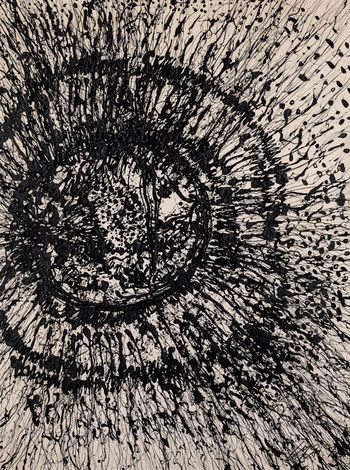

LOT 1841
IMAI TOSHIMITSU
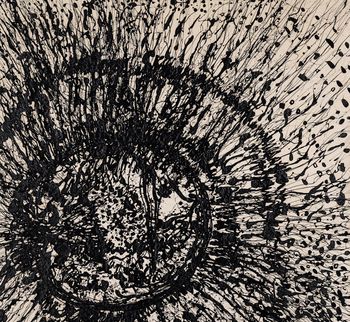
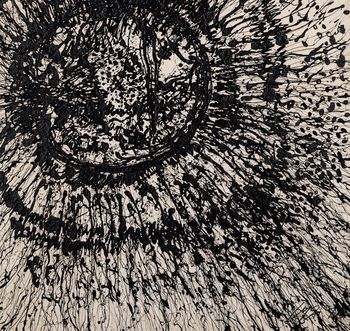
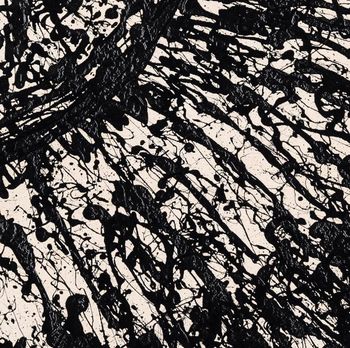
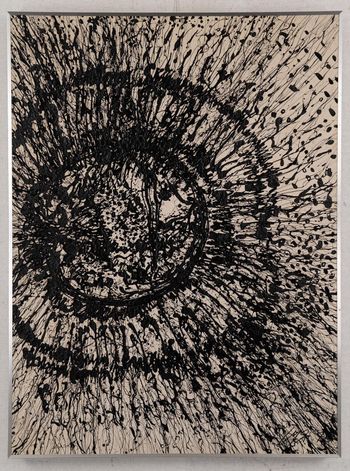
Soleil
| Medium | enamel on canvas |
| Format | framed |
| Dimensions | 129.3×96.0cm(50 ⅞ × 37 ¾ in.) |
| Date | 1973 |
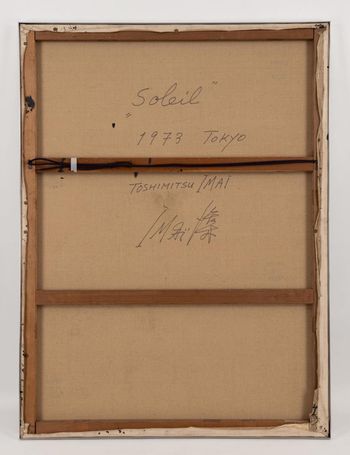
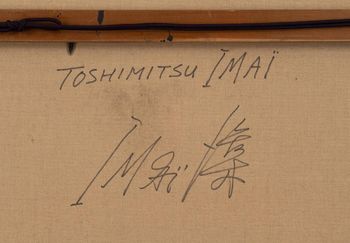
| Inscription | signed and dated titled, dated, inscribed with "Tokyo" and signed on the reverse Provenance: Takeda Art Co., Tokyo |
ABOUT THE ARTIST
After the Second World War, an art movement that flourished mainly in France emerged, promoted by critic Michel Tapié. Inspired by Jean Fautrier, Jean Dubuffet, and Wols, whose works reflected wartime anxieties, Tapié organized the 1951 exhibition Battle of Passions at Galerie Nina Dausset. Through the exhibitions What Informel Means and his book Un Art Autre, he defined lyrical abstractions with amorphous forms as Art Informel ("formless art"). While geometric abstraction like Constructivism was called "cold abstraction," Informel, with its emotional intensity, was often termed "hot abstraction."
Closely linked to the existentialism popular in France, Informel included artists such as Henri Michaux, Georges Mathieu, Pierre Soulages, Hans Hartung, and Japan-born Domoto Hisao and Imai Toshimitsu. In Japan, it was introduced in the 1956 exhibition World: Today's Art at Nihonbashi Takashimaya, gaining momentum the following year with visits by Tapié and Mathieu. Tapié promoted it widely, while Mathieu's live painting in a yukata drew public attention. These efforts sparked the "Informel whirlwind" in Japan, notably influencing Gutai Art Association members toward painting.
IMAI TOSHIMITSU, born in Kyoto, Japan, received his training at Tokyo University of the Arts. His early works were influenced by Fauvism, and in 1952, he won the Best Newcomer Award at the 15th Shinseisaku Salon. In the same year, he went to Paris to study medieval history and philosophy. In 1955, under the influence of art critic Michel Tapié, his style shifted towards abstraction. Imai exhibited at the São Paulo Biennale in 1953, held a group exhibition in Japan in 1956, and participated in the Venice Biennale in 1960. He received the Excellence Award at the 5th Tokyo Contemporary Art Exhibition in 1962. After 1970, he began incorporating text and Japanese cultural elements into his works, eventually addressing themes such as Japan's invasion of China and the Second World War.
Major Collections: the Ohara Museum of Art; the National Museum of Art, Osaka; and the National Museum of Modern Art, Tokyo.
CONDITION REPORT
Contact us
- Enquiries about our auctions
- Enquiries about the gallery
- Enquiries about the museum
- Requests for catalogues and reference materials
- Enquiries about Art News
- and more